Best DIY ways to tackle mold growth & moisture
Some of you may have been confused by this article title. Did I just have a spasm on the keyboard? NO! I decided it would be fun to try to use some of the language I learned in other countries (in this case Dutch), and incorporate them into some of my articles! Hopefully it doesn’t throw you off too much!
Anyway, on to mold!
When it comes to DIY ways to tackle mold growing, you want to make sure you are careful when you use any kind of bleaches or anything like that. I know that’s a very controversial thing, some people say “just throw bleach on it”, well a few things about Bleach:
Number one is it still has not been proven to disinfect mold on the porous surfaces like wood effectively can be done with bleach. The other thing is bleach is very very destructive to whatever you put it on including yourself. I don’t know if you’ve ever been exposed to bleach, but you certainly don’t want to be exposed to the fumes of bleach.
Another thing you want to make sure of before you start your DIY mold remediation or mold removal project is you want to make sure that whatever’s caused the mold, you have plans to correct it fairly quickly.
Make sure it’s all cleaned!
You don’t want to go in and remove all the mold, wait a month or two and whatever caused the mold is going to bring it right back. So if it’s high humidity, standing water, a plumbing leak, whatever the case may be, make sure you address that and dry out that area because the wood can be absorbing all that moisture. That’s not good, and you want to get a moisture level (also known as Vochtbestrijding in Dutch 🙂 )of the wood under probably 15% maybe even closer to 12%, and you can get a moisture meter like a surface moisture meter or a probe moisture meter to check the moisture content of the wood before you get started.
A couple of other notes I want to talk to you about is what they call protective equipment PPE, You want to make sure you have a mask and goggles, and you want maybe a Tyvek suit depending on if you’re sensitive. Put on gloves and of course safety things like that. You also want to put the area with the mold under negative air and perhaps use what’s called a HEPA air scrubber because once you start attacking that mold, it’s going to want to survive so it’ll start to spore. If you spray anything on it or you start rubbing it off, mold has a tendency to want to move to another place so you certainly don’t want it moving up into your house.
You put the area under negative pressure; you can move that mold spore out of your home instead of allowing it to go up inside your home.
Multiple DIY mold removal options are available!
There’s a couple of different options that people choose when they’re addressing mold. They’ll just spray it with a disinfectant and not remove it, and then they’ll also want it removed and disinfected, and then the third option is they’ll want it removed disinfected and then a protectant put on to ensure mold doesn’t come back.
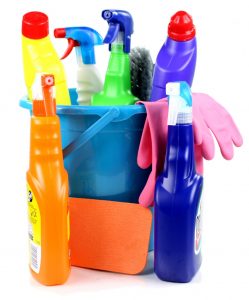 Keeping humidity low is in fact a protectant but they actually make some really good compounds to spray on the crawlspace to ensure that the mold does not return and I’ll get to those in just a second but the first thing you want to do is if you’re going to address the mold and remove it, we recommend the Anabec System. That is a wonderful peroxide-based system that attacks the food source of the mold and also disinfects the mold. It can be used for bacteria, viruses, different things like animal damage if you’ve got like a raccoon or a possum that got in there and destroyed the home and stunk up the place. It’s an excellent product for that.
Some of the other ways to physically remove the mold would be to use a HEPA vacuum cleaner. Now, these could probably be rented at Home Depot or Lowe’s, and if you had a shop vac you could add a HEPA filter to it so just using rags and brushes with a suitable disinfectant is the best way to attack surface molds.
One other thing, just remember that applying or just spraying a disinfectant on mold does not make the mold go away.
The last product I want to tell you about is the Anabec X70, and it is a water intrusion protectant as well as a mold preventative. It actually stops moisture from penetrating into the wood, kind of like sealing the deck or a stain on your deck does.
So it’s an excellent protectant to keep humidity out of the wood and different things like that it also uses a silver nanotechnology to kill mold spores.
I don’t know if you know this, but silver is a natural antifungal. If you want to put a protectant on your crawlspace to make sure the mold doesn’t come back, the X70 is what we use.
Now one last thing I do want to say about the X70 product is it’s not a substitute for dehumidification, so if you are still high humidity, if you’re over 60%, you want to make sure you control that humidity.
Okay well that’s all I had to share with you today, I really appreciate you reading this article, and I hope you liked the article and shared it and leave a comment and I’ll see you next time thanks again